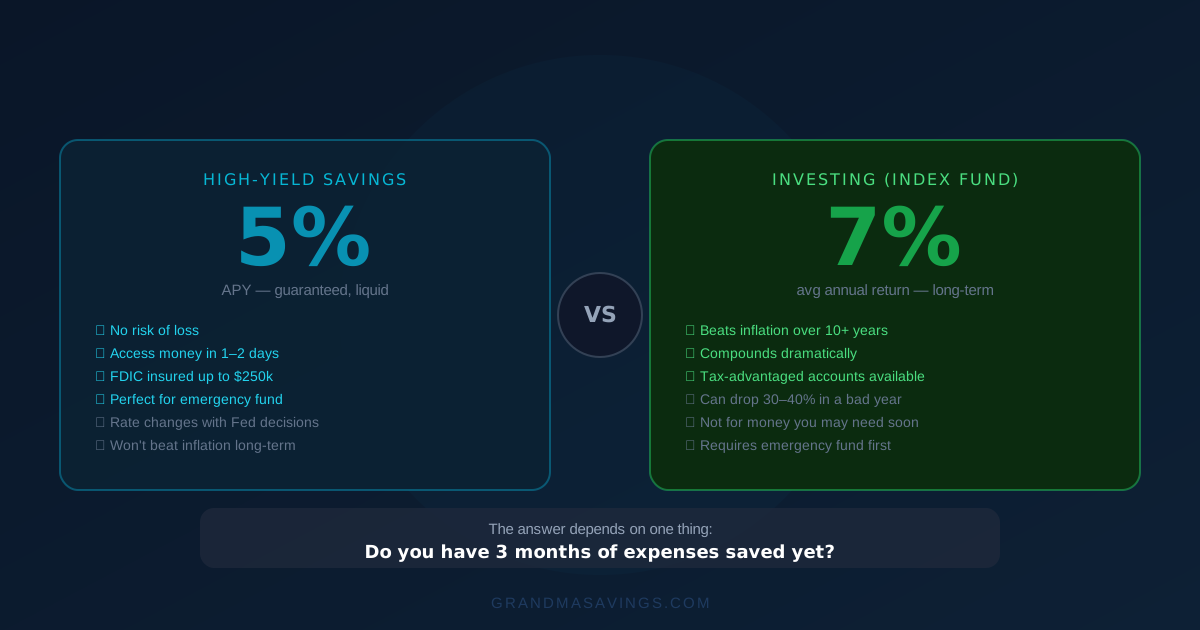
High-Yield Savings vs. Investing in 2026: What to Do With Your First $1,000
Savings accounts are paying 4-5% APY. The stock market historically returns 7-10%. So what do you do with your first $1,000? The answer depends on one thing — and it's probably not what you think.
You have $1,000. Maybe it's from a tax refund, a bonus, a gift, or a month where you actually spent less than you earned. Whatever the source, you now have a real financial decision to make.
And in 2026, that decision is genuinely harder than it used to be.
For most of the past decade, savings accounts paid essentially nothing — 0.01% to 0.5% APY at best. The answer to "save or invest?" was almost always "invest, because your savings will lose value to inflation either way." But the Fed's rate cycle has changed that calculus. The best high-yield savings accounts are now paying 4–5% APY, risk-free, FDIC-insured. That's real money.
So what do you do?
What's Actually Available Right Now
Before comparing options, let's ground this in real numbers from April 2026.
High-Yield Savings Accounts (HYSAs):
- Best available rate: ~5.00% APY (Varo Bank)
- Second tier: 4.21% (Axos), 4.20% (Newtek Bank)
- Traditional bank average: 0.38% APY (FDIC national average)
- Risk: None — FDIC insured up to $250,000
- Access: Funds available within 1–2 business days
- What $1,000 earns in one year: $42–$50
Stock Market (broad index fund, e.g. total US market):
- Historical average annual return: ~10% nominal, ~7% inflation-adjusted
- 2025 S&P 500 return: approximately +12% (market recovered strongly)
- Risk: Significant short-term volatility — the market can drop 20–40% in any given year
- Access: Funds take 2–3 business days to settle after selling
- What $1,000 might earn in one year: anywhere from -$300 to +$200 (genuinely unpredictable in the short term)
The numbers alone make it seem like a close contest. But there's a crucial factor that resolves the comparison quickly.
The One Question That Decides Everything
Do you have an emergency fund of at least $1,000–$1,500?
If the answer is no: put this $1,000 in a HYSA as the foundation of your emergency fund. Full stop.
Here's why this is not a close call:
If you invest your $1,000 in the stock market and then need emergency cash in the next 6–12 months (very likely, given that 47% of Americans can't cover a $1,000 emergency), you face three bad options:
- Sell your investments at whatever the current price is — which might be down 15%
- Put the emergency on a credit card at 22% APR
- Have no emergency fund at all and improvise
All three of these outcomes are worse than having your $1,000 safely earning 4–5% in a HYSA.
The emergency fund is not a savings strategy. It's the foundation that makes every other financial decision work. Without it, you're building on sand.
If You Already Have an Emergency Fund
This is where the comparison gets genuinely interesting.
If you have 3+ months of essential expenses in a HYSA and no high-interest debt, you have a real choice. Let's look at it clearly.
The case for the HYSA:
- 4–5% APY is real, risk-free money
- The Federal Reserve is holding rates steady — this environment could persist through 2026
- You preserve full liquidity
- No stress, no volatility, no decisions to make
The case for investing:
- Historically, stocks return 7–10% per year on average — roughly double the HYSA rate
- Time in the market beats timing the market
- At 30 years old, $1,000 invested and left alone could realistically grow to $10,000–$20,000 by retirement (assuming 7–10% average annual returns)
- Compound growth accelerates over time — every year you delay matters
The real answer: Invest the $1,000, as long as your timeline is 5+ years.
Here's the key: the HYSA's 4–5% APY is attractive today, but it's not guaranteed. When the Fed eventually cuts rates — which most forecasts place in late 2026 or 2027 — HYSA rates will fall with them. The stock market's historical average doesn't move with Fed policy.
If you're asking "what do I do with $1,000 I won't need for 5+ years?" the answer is: invest it in a low-cost index fund, every time. The 5% HYSA is better than doing nothing, but it's not a substitute for long-term investing.
The Sequencing Rule: A Framework for Every Dollar
Instead of deciding this in isolation, here's the framework that professionals use for prioritizing every dollar:
- Emergency fund ($1,500 minimum) — HYSA, not negotiable
- 401(k) employer match — capture 100% of it, it's an instant 50–100% return
- High-interest debt payoff — any card above 15% APR before investing
- Full emergency fund (3–6 months) — HYSA
- Roth IRA up to annual limit — currently $7,000/year for 2026
- Taxable brokerage account — index funds
Most people jump from #1 straight to #6, skip #2–4, and wonder why they're not getting ahead.
At any point in this sequence, you know exactly where your next dollar should go. Your $1,000 simply lands at whatever step you're currently on.
What "Investing" Actually Means (If You're New to This)
When most beginners say "investing," they imagine picking stocks — buying Apple, Tesla, or something their colleague mentioned. That's not what we're recommending here.
For your first investment dollars, the right move is almost always a total market index fund:
- FSKAX (Fidelity Total Market Index Fund) — 0.015% annual fee, $0 minimum
- VTSAX (Vanguard Total Stock Market) — 0.04% annual fee, $3,000 minimum
- VTI (Vanguard ETF version of VTSAX) — 0.03% annual fee, no minimum
These funds hold thousands of US companies — small, medium, and large — in proportion to their market size. When you buy one share of VTI, you own a tiny piece of Apple, Microsoft, Amazon, and 3,500 other companies simultaneously.
This diversification means you're not betting on any single company. You're betting that the US economy will be larger in the future than it is today — which has been true over every 20-year period in American history.
Cost matters enormously. The 0.015% fee on FSKAX means on $10,000 invested, you pay $1.50/year in fees. A managed mutual fund at 1.0% charges $100/year on the same balance. Over 30 years, that difference compounds into tens of thousands of dollars.
Running the Real Numbers: $1,000 Over 5 and 10 Years
| Scenario | Year 1 | After 5 years | After 10 years |
|---|---|---|---|
| HYSA at 4.5% (rate stays constant) | $1,045 | $1,246 | $1,553 |
| HYSA (rate drops to 2% after 2 years) | $1,045 | $1,139 | $1,280 |
| Index fund at 7% avg annual return | ~$1,000 ± | $1,403 | $1,967 |
| Index fund at 10% avg annual return | ~$1,000 ± | $1,611 | $2,594 |
The HYSA wins in year 1, potentially year 2. After that, the index fund almost certainly wins — but with volatility along the way.
The critical caveat: the index fund numbers assume you don't sell during a down year. If the market drops 20% in year 2 and you sell in a panic, you lock in that loss permanently. The 7–10% average only materializes if you stay invested through the dips.
This is why the emergency fund comes first — it's what allows you to leave your investments alone during a market downturn, because you don't need that money for emergencies.
The Practical Decision Tree
- No emergency fund → HYSA
- Have starter fund, have high-interest debt → pay the debt
- Have starter fund, no high-interest debt, need the money in under 3 years → HYSA
- Have starter fund, no high-interest debt, timeline is 5+ years → index fund
This isn't complicated. The answer is almost always the same once you fill in the variables.
If you want to know exactly where you stand and which step to prioritize first, GrandmaSavings' free financial diagnosis maps this out for your specific situation in about 5 minutes. You'll know exactly what to do with your next $1,000 — and the one after that.
The best financial decision you can make is the one you actually understand and will stick with. Start there.
Found this useful? Share it