How to Start From Scratch in 2026: A Complete Financial Reset Guide
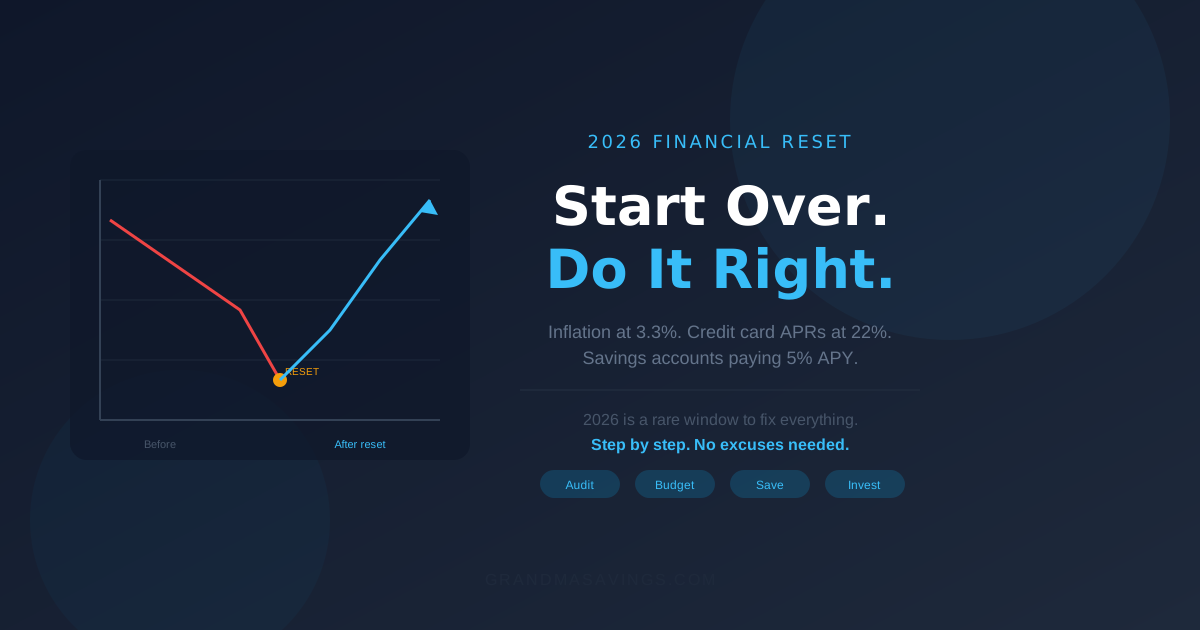
Inflation at 3.3%, credit card APRs above 22%, and savings accounts paying 5% APY. If your finances feel like a mess, 2026 is actually a rare window to reset. Here's the exact step-by-step plan.
Most people don't need a new budgeting app. They need a reset.
If you're reading this, you probably recognize yourself in at least one of these situations: you have credit card debt you've been ignoring, you have no savings cushion, your money disappears before the month ends, or you've started "getting serious about money" more than once and it never stuck.
That's not a willpower problem. It's a sequence problem — you've been trying to do things in the wrong order.
This guide gives you the right order. A four-step financial reset built for 2026's specific economic reality: elevated inflation, near-record credit card interest rates, and — for the first time in years — savings accounts that actually pay you meaningful money.
Why 2026 Is a Surprisingly Good Year to Reset
It doesn't feel like it, but the numbers line up in your favor if you act now.
Inflation is at 3.3% — annoying, but nowhere near the 9% peak of 2022. The cost of groceries, rent, and gas is painful, but it's predictable enough to plan around.
Credit card APRs average 22–24% — this is the number that should scare you. Every dollar you carry on a credit card is costing you roughly 22 cents per year, compounding monthly. That's a guaranteed -22% return on your money, which beats almost any market downturn.
High-yield savings accounts (HYSAs) are paying 4–5% APY — after years of near-zero rates, online banks are now offering real returns on your cash. Varo, Axos, and others are at 4–5% with no minimum balance requirements. That's the risk-free baseline you're working with.
The opportunity is real: if you stop bleeding 22% on debt and start earning 5% on savings, you've created a 27-point swing in your financial trajectory without changing your income by a single dollar.
Step 1: The Audit — 4 Numbers You Need to Know
Before you change anything, you need four honest numbers. This is the part most people skip, which is why most financial restarts fail.
Number 1: Net worth. Add up everything you own (savings, investments, car value, anything liquid) and subtract everything you owe (credit cards, student loans, car loan, any other debt). This number might be negative. That's fine. You need to know where you're starting.
Number 2: Monthly cash flow. What actually comes in each month after taxes? What actually goes out? Not what you think goes out — what your bank statements say. Pull the last 3 months and add it up. Most people are surprised to discover 15–25% of their spending is "unrecognized" — subscriptions, impulse purchases, convenience spending that doesn't feel like a decision.
Number 3: Debt list. Every single debt, sorted by interest rate from highest to lowest. Card name, balance, APR, and minimum payment. If any card is above 20% APR — and most are in 2026 — that's the first target.
Number 4: Credit score. Free through Credit Karma, your bank's app, or annualcreditreport.com. You don't need a perfect score, but you need to know what you're working with. A score above 700 opens up balance transfer options that can save you thousands.
Write these four numbers down. Everything else in this guide flows from them.
Step 2: Stop the Bleeding — Attack High-Interest Debt First
This is the step people want to skip because it's not exciting. But it is mathematically the most important thing you can do with money in 2026.
Any credit card above 20% APR must be priority number one. Not because of some financial philosophy — because the math is brutal. Let's say you have $6,000 on a card at 22% APR, paying only the minimum (around $120/month). At that pace, it will take you 7+ years to pay off, and you'll pay over $5,800 in interest alone — nearly doubling what you borrowed.
There are two methods to choose from:
The Avalanche Method — pay minimums on all debts, then throw every extra dollar at the highest-APR card first. This is mathematically optimal. It saves the most money.
The Snowball Method — pay minimums on all debts, then attack the smallest balance first regardless of rate. This is psychologically powerful. Eliminating a card completely gives you momentum that keeps you going.
Both work. Pick the one you'll actually stick to.
The underused tool: balance transfers. If your credit score is above 680, you may qualify for a 0% intro APR balance transfer card — some offer 15–21 months interest-free. Moving $6,000 from a 22% card to a 0% card and paying it down over 18 months saves you roughly $2,000 in interest. There's usually a 3–5% transfer fee, but the math still wins by a wide margin. Calculate whether the transfer fee is less than the interest you'd pay at your current rate.
One rule while in debt-attack mode: pause investing. If you're contributing to a non-employer-matched investment account while carrying 22% credit card debt, you're paying 22% to borrow the money you're investing at an expected 7–10% return. The math doesn't work. Stop the higher-rate bleeding first.
The one exception: employer 401(k) matches. If your employer matches contributions up to some percentage, take the full match — it's an instant 50–100% return that beats 22% APR.
Step 3: Build the Foundation — Emergency Fund + HYSA
Once your highest-rate debt is eliminated (or significantly reduced), you have one job before you start investing: build a real emergency fund.
Why this comes before investing: Without a cash buffer, the first car repair or medical bill sends you straight back to the credit card. Every financial reset that doesn't include an emergency fund fails at the first obstacle.
The 2026 minimum: $1,500–$2,000 is a starter emergency fund. It won't cover everything, but it covers most single-event emergencies (car repair, medical copay, appliance failure). That's your first milestone.
The real target: 3 months of essential expenses. Not your current spending — just the essentials: rent/mortgage, utilities, food, transportation, insurance, minimum debt payments. Calculate that number and multiply by 3. For most American households, that's $6,000–$12,000.
Where to keep it: A high-yield savings account, not your regular checking. The best HYSAs in 2026 are paying 4–5% APY — that means $10,000 sitting in your emergency fund earns $400–$500/year without any risk. Compare that to a traditional savings account at 0.38% (the FDIC national average), which earns $38/year on the same amount.
Some solid options as of April 2026: Varo Bank (up to 5.00% APY), Axos Bank (4.21%), Newtek Bank (4.20%). These are FDIC-insured — your money is protected up to $250,000.
One practical tip: keep your emergency fund at a different bank than your checking account. The slight friction of transferring money is a feature, not a bug — it makes you pause before dipping into it for non-emergencies.
Step 4: Resume Building — When to Start Investing and How to Automate It
You've done the hard part. Now you get to do the part that actually builds wealth.
When to start investing: Once you have at least one month of emergency savings and have eliminated any credit card debt above 15% APR, you're ready to start investing. You don't need to finish building your full emergency fund first — you can build both simultaneously after the highest-rate debt is gone.
Start with your employer's 401(k) or 403(b) — at minimum, capture the full employer match. Then, if eligible, open a Roth IRA. The 2026 contribution limit is $7,000 ($8,000 if you're 50+). A Roth IRA grows tax-free, and you can withdraw your contributions (not earnings) penalty-free in an emergency — making it a flexible vehicle for long-term savings.
Keep it simple. A total market index fund (like FSKAX at Fidelity or VTSAX at Vanguard) gives you instant diversification across thousands of US companies at minimal cost. You do not need to pick stocks. You do not need a financial advisor to start. Pick a low-cost index fund and automate monthly contributions.
Automation is the secret. Set up automatic transfers from your checking to your savings and investment accounts on the day after payday. Pay yourself first. What you never see in checking, you never spend.
A simple automated setup:
- Day 1: paycheck hits checking
- Day 2: automatic transfer to emergency fund (HYSA) until target is reached
- Day 2: automatic contribution to 401(k) via payroll (already deducted pre-tax)
- Day 2: automatic contribution to Roth IRA
Once your emergency fund is fully funded, redirect that automatic transfer to your investment account.
The Reset Mindset
A financial reset isn't about perfection. It's about direction.
You don't need to do all of this in a week. The audit might take a weekend. Attacking debt might take 18 months. Building your emergency fund might take 12 months after that. That's fine — the timeline matters far less than whether you're moving in the right direction consistently.
The most important step is the first one: doing the honest audit. Every improvement that follows gets easier once you know exactly where you stand.
If you want a shortcut to knowing where you stand — and a personalized roadmap to your specific situation — GrandmaSavings' free financial diagnosis gives you a complete picture in about 5 minutes. It maps your current situation to a realistic path, without any obligation to upgrade.
Start there. The reset starts the moment you see the numbers clearly.
Found this useful? Share it